Friday, June 8, 2012

Ruth Kern Woodland Preserve, Fulton County

http://www.acreslandtrust.org/templates/System/details.asp?id=44551&PID=701955

     I took my latest nature walk alone.  I so enjoyed the quiet and solitude of my hike at Asherwood that I decided to go solo once more.  It was fine.  Lovely, really, but near the end, I was ready for some company.


     The Ruth Kern Woodland preserve contains a wide variety of growth from hardwoods, to pines, to the bank of the Tippecanoe river, to ponds, streams and wetlands.  I was captivated by the abandoned Christmas tree farm that used to occupy this land.
Remnants of the Kern family Christmas tree farm, active from the 50's to the 80's.
      But what was once a Christmas tree farm is now a thriving pine forest, my favorite kind of forest to hike in.  I love the carpeting of fallen pine needles which can make your footsteps almost silent.  Breathing in the sharp pine scented air is almost heaven to me! 
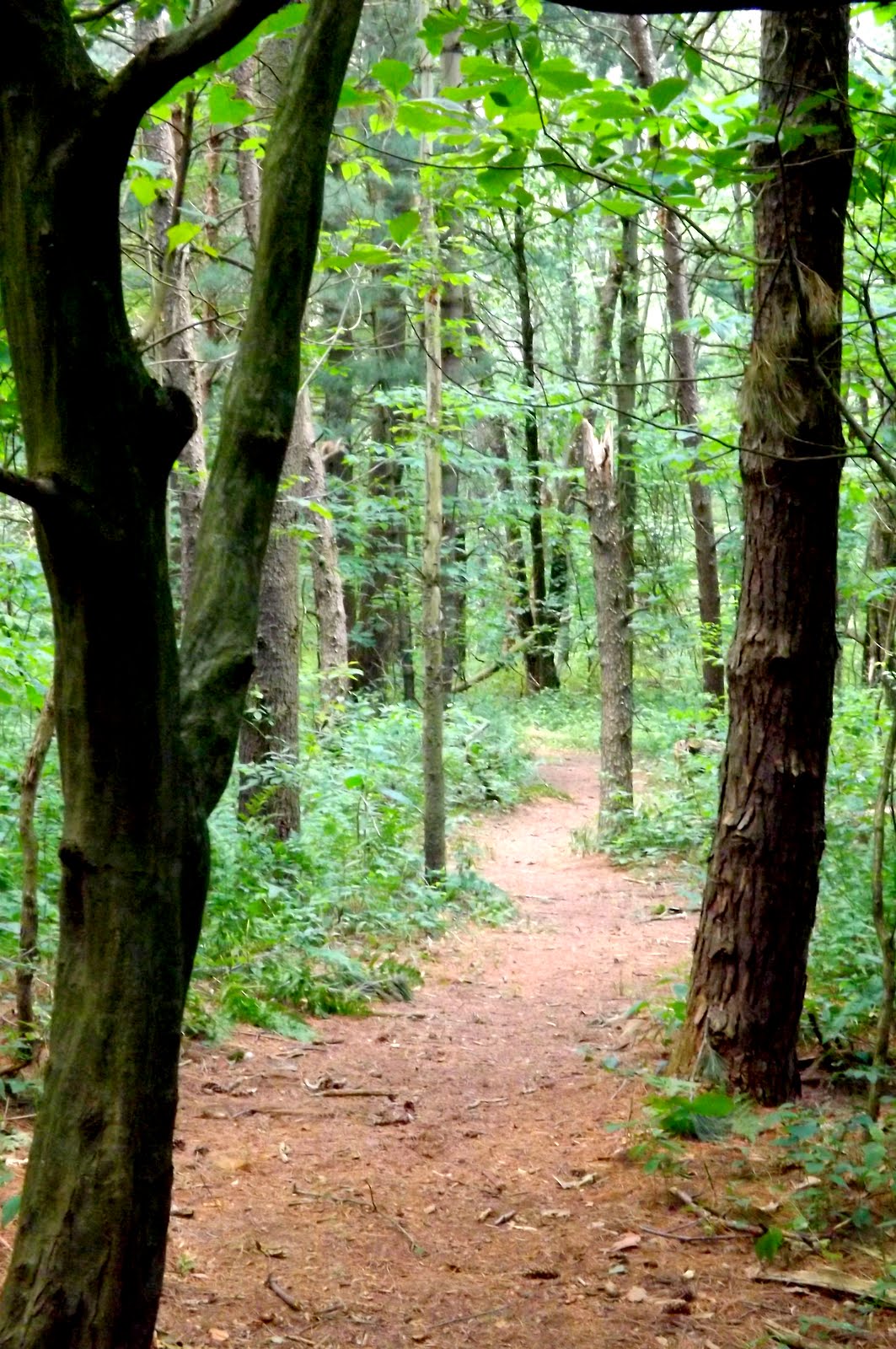
I find this winding, pine needle covered path so enchanting!
There is nothing like being enveloped in a towering stand of pines to make you
 feel small and insignificant...and alone.
     In fact, it was in this pine forest that I almost met death. I was meandering down the path in the photo above, when I startled a family of deer, big ones, causing them to scamper away.  Only their "scamper" sounded more like a stampede to me, complete with the thunder of beating hooves and vibrations traveling through the ground to shake my already trembling knees. The scariest part was that I couldn't see them through the woodsy growth.  So I knew they couldn't see me.  And I just knew they were going to burst through the forest, onto my trail, and trample me to death. Thankfully, deer aren't completely stupid, and tend to run away from human smells and sounds, not toward them.  Whew! Untimely demise averted.
     Only later, when I had (sort of) returned to my senses, did I conclude that I was probably never in any danger. However, from this moment on I was shaken, and began to see the forest in a different, more sinister light.  Now I wished I had some company!
Neat visual line pattern? Or reaching branches with a mind of their own...
"The branches bent down and twined around him."
~The Wonderful Wizard of Oz
It struck me odd that these trees were growing so closely together, as if they are huddling in some whispered conversation.
The Ruth Kern preserve was once Camp Wright, a camp serving boy scouts from
eastern Chicago from 1932 to the 1950's.  This duckweed covered pond was once their swimming hole.   It looked harmless enough.  Until I saw these creepy things...
Many of these short and stout, knobby and weird little things littered the pond's edge.  I now know that these are called Cypress Knees, and are woody growths that project upward from the roots of the Bald Cypress.  Before I looked them up, I was convinced they were the Swamp Thing's little brothers rising up from the depths.
Swamp Thing
Created by Len Wein and Berni Wrightson, first presented by DC Comics in 1971.


     As I stood surveying this lovely, serene vista, I thought my mindset was shifting toward a more positive (less freaked out) outlook.  One that could enjoy the beauty and tranquility of the forest.  But around the next bend, I met this guy...
Don't you recognize him?  
Davy Jones
Pirates of the Caribbean: At World's End, 2007
     At this point I was very done with my solo hike, my rattled nerves could take no more!  Thankfully I was at the end of the trail system and very close to the parking lot, where I dove into my vehicle and sprayed gravel as I high-tailed it outta there!  This hiking alone thing is overrated!  

     All joking aside, it was a beautiful day for an enjoyable hike, regardless of the stampeding wildlife.  Despite the questionable state of my nerves, I was able to get a few more nice pics to share. Enjoy!  
Layers of texture: pebbles, duckweed, water
Glad to know I wasn't completely alone!
Pods of the Redbud tree.

See you next time...with my full entourage!!

Thursday, June 7, 2012

Dygert Nature Preserve, Whitley County

     The true name of this site is the Evelyn and Wendell Dygert Nature Preserve.  So my own Evelynn was my sole companion on this outing.
http://www.acreslandtrust.org/templates/System/details.asp?id=44551&PID=635752
By the end of our hike, Evelynn was vowing to never hike with me again. Ever.  More on that later.


One of the many picturesque trails running throughout this preserve. 

This steep sided ditch has water running through it.
I was glad to see that ALL the water in Indiana hadn't yet dried up!
     As Evelynn and I explored the trails and paths running through the preserves, a common theme kept popping up...food!  (It didn't help that we had not yet had lunch.)  One of the first things we happened upon was a cluster of cherry trees, ripe for the picking.  
So red and looking delicious!
Unfortunately most of the cherries were already claimed by the little white larvae worms of the Western Cherry Fruit Fly. In the spring, adult flies lay eggs under the skin of the cherries, and in a larval form, the maggots feed on the meaty insides of the cherry. 
     My family is full of anticipation for the opportunity to collect the season's first haul of ripe black raspberries.  Soon...
 Wild Black Raspberries.  Give these another week or so and Dygert Preserve will have some very happy birds and critters!
     This Stiff Dogwood bush was covered with clusters of pretty blossoms...providing yummy nectar for lots of bugs!  (Although Evelynn and I agreed they smelled pretty stinky to us.)
I didn't see him at first, but this cluster of flowers is providing a smorgasbord for a tiny beetle. (He is near the lower right of the cluster.)
This Giant Swallowtail butterfly appreciates a helping of the Stiff Dogwood as well.
     Our own rumbling tummies kept us painfully aware of the evidence of eating going on around us. 

This Red Admiral butterfly enjoys a sip of Prairie Fleabane nectar.
These squiggly whitish lines are created as the larvae of a leaf mining insect eat their way through the interior of the plant's leaves.  
The bark of this Ash tree has been ripped away by birds desperately seeking to make a meal of the Emerald Ash Borer insects inside.  
The Emerald Ash Borer has eaten his fill of this tree.  This small D shaped opening is his exit hole.
Even this tree appears to be eating a strand of barbed wire.  Yum.
      I am certain this lovely Scarlet Catchfly flower would make an appetizing meal for some hungry butterfly or bee.  However, it was in pursuit of an eye-catching photograph of said flower that Evelynn got the chance to test out a recent hypothesis.
Scarlet Catchfly
She was so excited to snap a pic that she threw all hiking-caution to the wind, veered off the path and struck a course toward the flowers...straight through a patch of Stinging Nettles! 


Stinging Nettles are covered with tiny hollow stinging hairs called trichomes on its leaves and stems.  These hairs act like hypodermic needles, injecting histamine and other chemicals that produce a stinging sensation upon contact with skin.  

     This was not Evelynn's first run-in with stinging nettles this year.  Last time, her Mamaw told her about a simple treatment to take away the nasty sting and itch of the attacking nettles.  So today, Evelynn had the opportunity to test out her hypothesis...MUD!


Evelynn poured her bottle of water out onto a mound of turned up soil, and mixed it to make thick mud.  
She then rubbed the mud onto her itchy, burning, nettle infested legs.
 "Thanks for the tip, Mamaw!"  Much to Evelynn's relief, the mud-method of nettle stinger removal worked!! However, any possibility of hitting the first quality restaurant we passed on the way home was now reduced to fast food drive-through options only!
The theory is that as the mud dries, it shrinks and pulls those little nettle stingers out of the skin.  
     Despite their painful sting, nettles are actually an extremely nourishing leafy vegetable known for their nutrients and pleasant flavor.  When simmered in a little water for ten to twenty minutes, the tiny stingers dissolve leaving a completely edible spinach-like vegetable.  Nettles are rich in protein, iron, calcium, vitamins A, C, and B-complex, and many essential trace minerals.  Even the water used for cooking the nettles can be sipped as a hearty, healthy broth or tea!  Find very helpful Nettles info here... 
http://suite101.com/article/stinging-nettle-a22028     At this point Evelynn wanted no more to do with nettles, mud, or even hiking with her dear old mom.  And still hungry (make that ravished with abominable appetite!) she was ready to eat anything she could find.  And that included sucking the nectar from the florets plucked off the head of this Red Clover. I remember doing this when I was her age. 


Red Clover can be used in many ways, for many reasons.
http://tlc.howstuffworks.com/family/red-clover-herbal-remedies.htm
     We eventually ended our hike, and even though she says she will no longer be my outdoor adventure partner, I think Evelynn will find it hard to stay away.  Especially if she knows there will be Red Clover available!


"Nature provides a free lunch, but only if we control our appetites."  ~William Ruckelshaus


Tuesday, June 5, 2012

Asherwood Nature Preserve, Wabash County

http://www.marion.k12.in.us/asherwood.cfm
     From a family affair to a solo flight.  On my previous hiking adventure I had the pleasure of being accompanied by my whole family.  The day I visited the Asherwood nature preserve in Wabash county, I went alone.  At first I was disappointed that my children would choose to bail on dear old mom...but I very soon came to realize that hiking alone provided blessed calmness and quiet. 


Asherwood preserve straddles Asher Creek. 
  The Asherwood Environmental Science Center is a 160-acre environmental science education facility that has been owned by the Marion Community Schools, Marion, Indiana since 1974 and is currently being operated by Acres Land Management.  Asherwood is one of Acres's several partner preserves.


One of three ponds found at Asherwood.  This is called "Frog Pond."  While here I was serenaded by the deep, throaty croak of several bullfrogs.  Although I saw none, I know I was being watched.  
     Besides the creek, streams, ponds, deep ravines, narrow ridge tops, and upland and floodplain forests, Asherwood is also home to an outdoor aviary.  I was startled, but pleasantly surprised, when the trail led me to these guys...
Red Tailed Hawk.
Nickname: Chicken hawk.  They received this nickname after being blamed for taking poultry farmers' chickens, although they rarely prey on standard sized chickens.
Great Horned Owl.
The Great Horned Owl is referred to as “the tiger of the sky” because of its fierce nature and ability to capture a wide variety of prey that may be larger or heavier than the owl. The Great Horned Owl is one of the few species that occasionally preys on skunks.
Barred Owl.
This owl's common nicknames include Black-eyed Owl, Swamp Owl, and Laughing Owl.  The Barred Owl is a vocal bird and can make many different sounds from hoots to screams, and barks to laughter. Its most distinctive call sounds somewhat like the phrase, "Who cooks for you, who cooks for you all."  
Turkey Vulture.
I've always known these birds as "Turkey Buzzards".  They are quite common around here especially where there's fresh roadkill.  However, the word "buzzard" actually refers to several species of hawks. (So the Red Tailed hawk is more of a buzzard than this guy.)  The mis-naming of vultures as buzzards probably dates back to the arrival of the first English colonists to America. There are no vultures of any type in England, so it is logical that these pioneers probably gave the common term "buzzard" to any large flying birds.


     I was sorry my kiddos missed meeting my fascinating feathered friends. But I confess, I did not miss playing referee all day between Miss Bossy Pants and Mr. Wild Man-wannabe.  In fact, without distractions I was able to become more sensitive to the sights and sounds around me...

Like this amazing pattern of dappled shadow and light in a sandy stream bed.
And these teeny-tiny, perfectly shaped leaves.  
Or the combination of reflected colors and shapes of the sky and tree, combined with the dappling of shadow and light in this small water pool.
     I also became aware of an abundance of different textures present in my surroundings. As an art teacher, I teach about two categories of texture: tactile (or actual) texture that you can sense with your hands when you feel it.  And visual texture that you can sense with your eyes when you see it. The forest is filled with tactile textures that I attempted to capture with my camera and translate into visual texture.  
Submerged old leaves covered with duck weed at Frog Pond.
Wild Gooseberries.
In spite of those spiky barbs, wild gooseberries are, indeed, edible.
You must cook them first to soften those spikes.
A cluster of ginkgo leaves.
The Ginkgo is a living fossil.  Fossilized plants recognizably related to the modern
Ginkgo date back as far as the Permian period,  270 million years ago!
I love the layers of texture in this photo:
 the large rock plates on the left, the rippling stream in the center,
and the patch of pebbly stones on the right.
Peeling bark of the American Sycamore tree.
 I think it looks a bit like camouflage, don't you?
Yellow Sweet Clover.  


     I began my hike a bit miffed at my offspring for straying from our planned hiking day.  However, in retrospect, I am grateful for the opportunity to experience nature free from distractions, in peace and quiet, and at my own pace.  I WILL be doing this again!