|
| Chicago, IL |
In late summer my family and I traveled to
Chicago to do some sight seeing. We of course stopped off at the Shedd Aquarium
and Navy Pier.
While wandering through Navy Pier's vast shopper's paradise we stumbled
upon a treasure trove of stained glass windows!! Housed within Navy Pier's
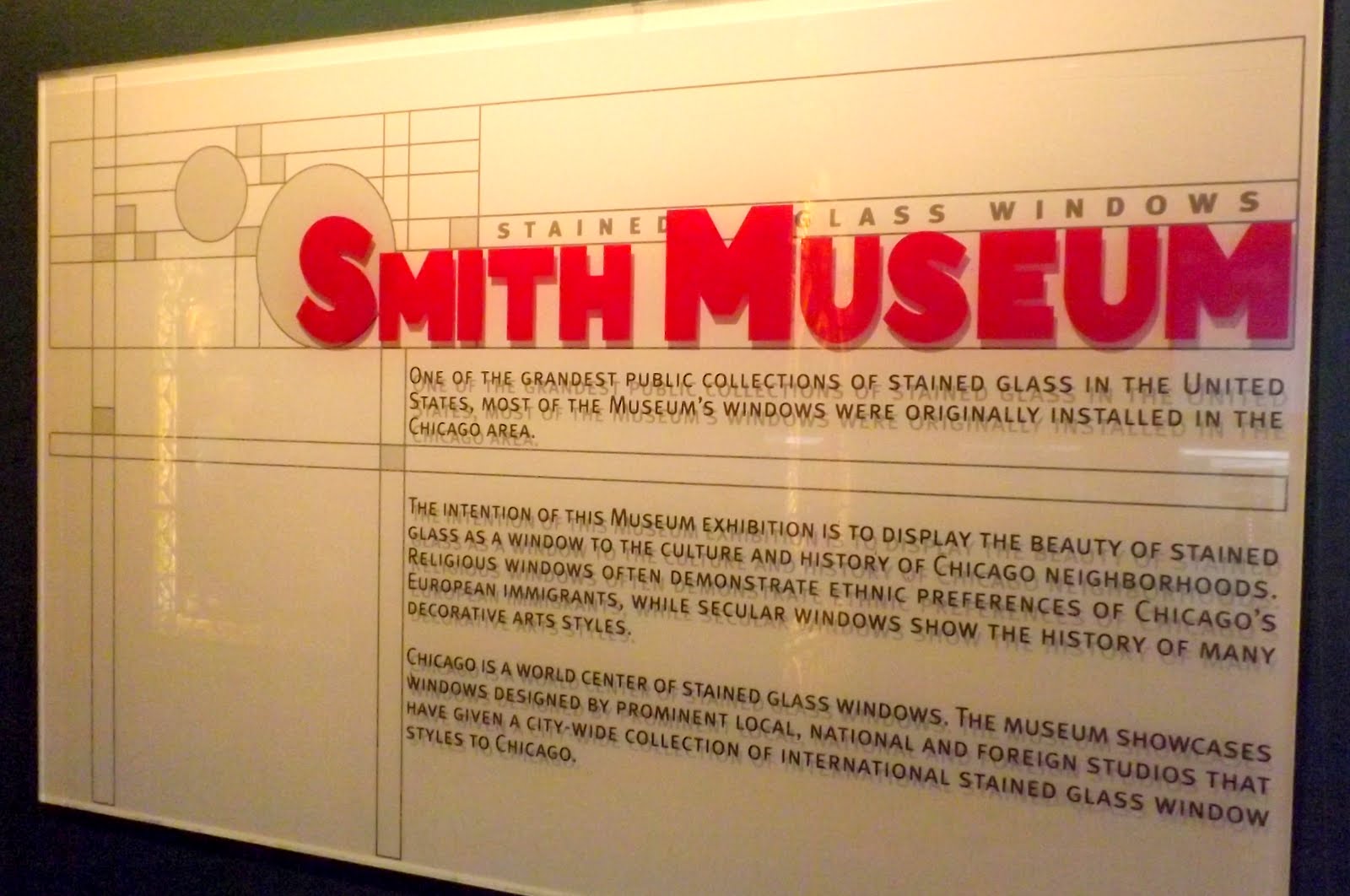
Festival Hall is an entire stained glass museum...what luck!! The Smith Museum of Stained Glass Windows is
a permanent display of 150 stained glass windows displayed in an 800 foot long
series of galleries.
Open since February 2000, The Smith Museum is the
first, and only, museum in the United States dedicated solely to stained glass
windows. It showcases both secular and religious windows and is divided by
artistic theme into four categories: Victorian, Prairie, Modern and
Contemporary. All of the windows were designed by prominent local, national and
European studios and most were originally installed in Chicago area buildings.
 |
| Landscape With Yellow Sky, Louis Comfort Tiffany, 1915 |
Imagine my delight when I discovered that within this amazing stained glass wonderland were 13 windows designed in the Louis Comfort Tiffany Studio! I was standing mere inches away from stained glass creations that had come from Tiffany's studio in New York City! I confess...I embarrassed by daughter more than a few times with stifled "eeeks!" of excitement.
 |
| Evening Landscape, Louis Comfort Tiffany, 1910 |
Tiffany first began experimenting with glass art in 1873. He opened the Tiffany Glass Company in 1885, which then became the Tiffany Glass and Decorating Company and later Tiffany Studios. After designing hundreds of beautiful windows for churches, public buildings, and homes of his wealthy clients, Tiffany became one of the most well-known glass designers in the United States.
 |
| Landscape With Waterfall, Louis Comfort Tiffany, 1920's |
For me, and many other glass artists, being able to see Tiffany's designs in person, and to be able to get up close and study his physical methods of glass craftsmanship was incredibly inspiring. Tiffany incorporated some revolutionary techniques in his designs that simply do not translate through textbooks or internet photos.
 |
| Autumn Landscape, Louis Comfort Tiffany, 1890's |
Louis Comfort Tiffany treated glass art differently than any
artisans had since the Middle Ages and the Renaissance. For example, Tiffany studied the distortion
effects of light in wine bottles and discovered that imperfections, like
streaks of lighter or darker areas, in sheets of glass could be used to depict
atmospheric colors such as during a sunrise. His conclusions led him to experiment with entirely new types of glass, including
opalescent glass, to portray atmospheric conditions. His radical new treatment of stained glass windows didn't stop there...
Tiffany explored using dimensionally formed drapery glass to mimic folds of fabric in clothing.
 |
| The texture in this angel's dress have been specially formed to mimic the folds of actual fabric. |
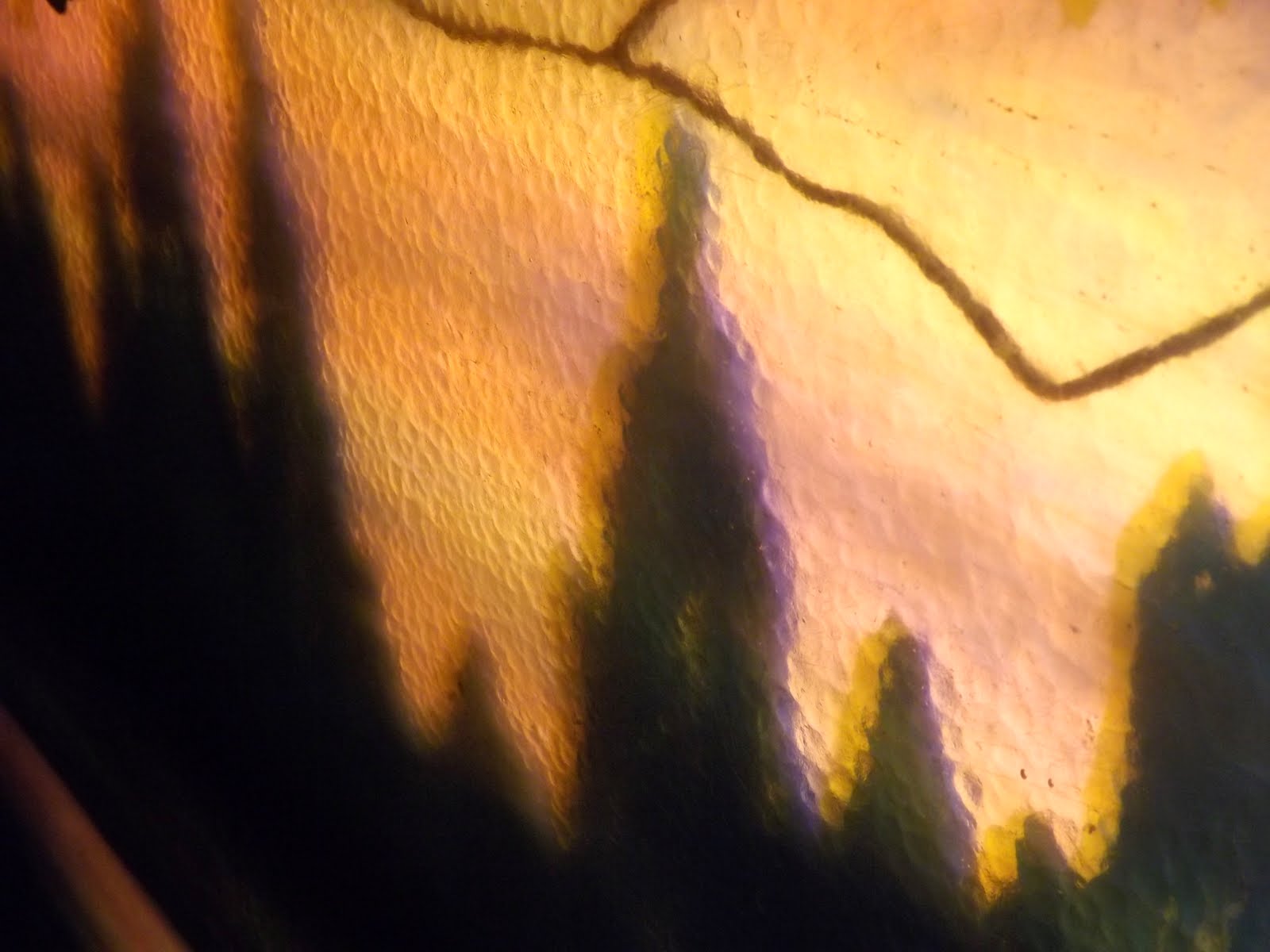
He utilized mottled glass to emulate the dappled
effect of sunlight through leaves.
 |
| Close up of tree foliage created using mottled glass for a sun-dappled leafy effect. |
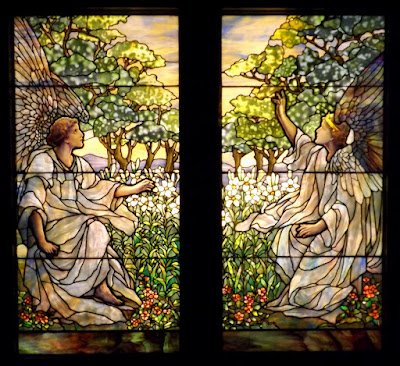 |
See that mottled, leafy-looking glass near the top of this window?
Angel Pair, Louis Comfort Tiffany, 1910 |
By strategically placing striated glass, Tiffany could evoke
the movement of water.
 |
| Close up of the waterfall seen in Landscape With Waterfall. |
Tiffany also began to incorporate non-traditional objects
such as seashells, pebbles, and large faceted chunks of jewel-like glass.
 |
| Large glass chunks incorporated into a stained glass window design giving a jeweled appearance. |
Tiffany even created a practice called “plating” which refers to the technique of placing several pieces of glass one behind the other. By plating various pieces of glass into one composition Tiffany created the impression of depth of color and of geographic distance.
 |
| In this photo you can see how the section of green is mounted atop the rest of the glass panel. |
 |
| The bottom section here (the area that looks less in-focus) is a section of glass plated atop another piece containing the pebbly detail. The top glass softens the details of the bottom glass to create the illusion of distance. (Close up detail from Landscape With Waterfall) |
 |
| Another example of plating a solid glass atop a detailed layer to create atmospheric perspective. In this window, Evening Landscape, the skyline detail of the bottom layer of glass has been painted on. |
Painting the finer details of a design on the glass's surface was not a new technique during Tiffany's time. Glass artists practiced the art of "staining" glass during the Middle Ages and the Renaissance. Tiffany also used this tried and true method of creating dramatic details in some of his glass creations, especially those featuring people.
 |
| Painted detail from Angel Pair |
Even though I've chosen to focus on the awe-inspiring designs of the Louis Comfort Tiffany Studios here, I would be remiss if I didn't mention the amazing abundance of crazy-awesome stained glass windows on display at the Smith Museum. There are designs by renowned stained glass artists John LaFarge and Frank Lloyd Wright, as well as Chicago artists Ed Paschke and Roger Brown. There is even a very large window designed by the successful female glass designer, Marie Herndl.
The museum also presents unique contemporary pieces including stained glass portraits of Dr. Martin Luther King, Jr., Michael Jordan and a window created from soda pop bottles. I found it very interesting to see how modern stained glass designers incorporated some of the techniques that Louis Comfort Tiffany developed during his lifetime, such as...
...the use of dimensionally formed drapery glass to mimic folds of fabric...
 |
Jerusalem Mount Zion Window in King David's Tomb, 1998
Designed and fabricated by Isaac Malis |
 |
This formed glass creates the look of a fabric curtain hanging in a window.
At first glance one could forget that it is made of hard, brittle glass. |
...the incorporation of non-traditional objects such as large chunks of dimensional glass...
 |
Slab Glass Composition, 1960
Designed and fabricated by Conrad Schmitt Studio |
 |
| This piece is constructed largely of thick slabs of irregularly shaped glass. |
...and contemporary glass artists still engage in the age-old practice of painting on the surface of the glass...
 |
Roger Brown Silhouette Window, 1999
Designed and fabricated by Botti Studio |
Please stay tuned as my family and I continue our journey through Chicago, and discover more stained glass treasures along the way...see you at the Art Institute of Chicago!