Showing posts with label winter. Show all posts

Wednesday, July 17, 2013

"Winter" in Stained Glass


      Over a year ago I embarked on a journey that would take me on many nature hikes during every season. The visual images that filled my camera have become the inspiring fuel powering my culminating project for the 2012 Lilly Teacher Creativity Fellowship Program. I have been designing and creating 4 large stained glass panels, each depicting one of the four seasons. My last blog post detailed how I created an homage to springtime using the copper foil method.
Tree of Life window by Frank Lloyd Wright
DarwinMartin House, 1904, Buffalo, New York
      When I had finally completed "Spring," it was time to move on to the next panel.  Logically, Summer would have been next, right?  Not so if you are the proud owner an ADD brain like mine. I was beating my head against the proverbial wall attempting to force onto paper something resembling a summery design. So I procrastinated - my preferred coping mechanism.  In the meantime, my family had taken a trip to Chicago (read about that here and here) where we visited the Art Institute. While there I stumbled upon some leaded glass windows by several Craftsman style artists including Frank Lloyd Wright, one of my favorites. From then on, I was determined to create at least one of my panels using characteristics of the Craftsman, or Prairie, style...strong geometric lines and shapes, earthy and neutral colors, lots of symmetrical patterns.
It didn't take long for me to abandon realistic designs (that weren't flowing very freely anyway)
 for a more geometric interpretation of nature.  
            Since I was failing miserably at coming up with a great realistic interpretation of something summery, I decided to abandon that approach and try a complete reversal...a new season, and a new style. It was kismet. I had recently taken a winter hike just down the road at a nearby nature preserve, and had some fresh photos on my camera. (Yes, I procrastinated right through Autumn!) I got lucky; I took only one winter hike and from that hike had the photos I needed to formulate a design plan for "Winter!"  
This picture contains the color palette that I would use in my "Winter" panel:
white, grayish, light amber, and dark amber.
      The winter landscape lends itself nicely to a Craftsman style interpretation in many ways.  The colors of an Indiana winter are very neutral with lots of white, grays, and various shades of amber or brown.  The absence of most foliage and undergrowth allows the geometric lines and patterns of the tree branches, fallen logs, and naked plants to become the main scenic focus.  
I liked how these dead, snow covered leaves took on a diamond appearance, and decided to use the diamond shape in a pattern in my panel - amber on the bottom, white on top.
The strong diagonal angles in this photo would be almost completely hidden from view on a summer's day.  The angular elements of this photo inspired the structure of my "Winter" panel.

            After perusing my collection of wintery photos and determining how I would use them in my design, I came to the conclusion that this would be a good time to part ways with the copper foil method of making stained glass.
The challenge in constructing a stained glass design in this way is that all the pieces are somewhat mobile until the solder is added last.  You can see that I've used horseshoe nails to hold everything steady until then.

       Luckily, I had recently completed a class at GlassLink in Fort Wayne where I learned (or rather, re-learned) how to create a stained glass panel using the leaded glass technique.  You can read a detailed description of this method here and here. Rather than using adhesive copper foil tape on each glass piece, I would be using lead came to interlock all the glass pieces together, then solder them in place.
"Winter's" design is taking shape.

       One of several advantages of the leaded glass method is that there is very little need to grind each piece of glass after it's cut, since the edges will be hidden inside the lead channels. With no grinding and no foiling, this panel went together rather quickly. After all the pieces are locked in place with the lead came, it's time to solder.
The only soldering needed is at the joints. 
Where each section of lead came comes together, a blob of solder is added to cover the gaps and create a permanent connection.

      Another advantage is the soldering routine.  When surrounding each piece of glass with lead came, it eliminates the need to add more lead solder as in the copper foiling method. Therefore, the only soldering necessary is at the joints.  A panel this large done in the copper foil method would take at least a couple of hours to solder just one side.  Using this method, I was done with both sides in just under 30 minutes!
The magical chemical that changes all silver to black with just the swipe of a paintbrush!

      Only one step left before framing: patina!  Lead in it's natural state is generally silver. The stained glass artist has a choice of leaving it silver or chemically altering it to look black.  Most of the time the artist makes this choice based on how it will effect the overall look of the design.  I decided my lead needed to be black.  
So easy...brush it on - instant black! 
I've learned to avoid too much skin contact, as it will turn your  hands black, too.  And not in a patina kind of way, in a chemical burn kind of way!

      After a quick wash, and some help from my Frame-Guy (dear old Dad), I have successfully completed panel #2, "Winter!"  So very different from the "Spring" panel, but a tremendous learning experience!

I love how this Craftsman style panel interprets winter imagery in a geometric, abstract way.

This multiple personality panel looks very different when viewed in different environments and lighting.  This is a view with the light source from the backside. 

There are areas of a special iridized glass in this panel. I think the trickiest part of the entire project was getting photos to show the iridescent shimmer!   

TWO down, two to go! 
Stay tuned to see what seasonal glass creation I came up with next.

Friday, February 15, 2013

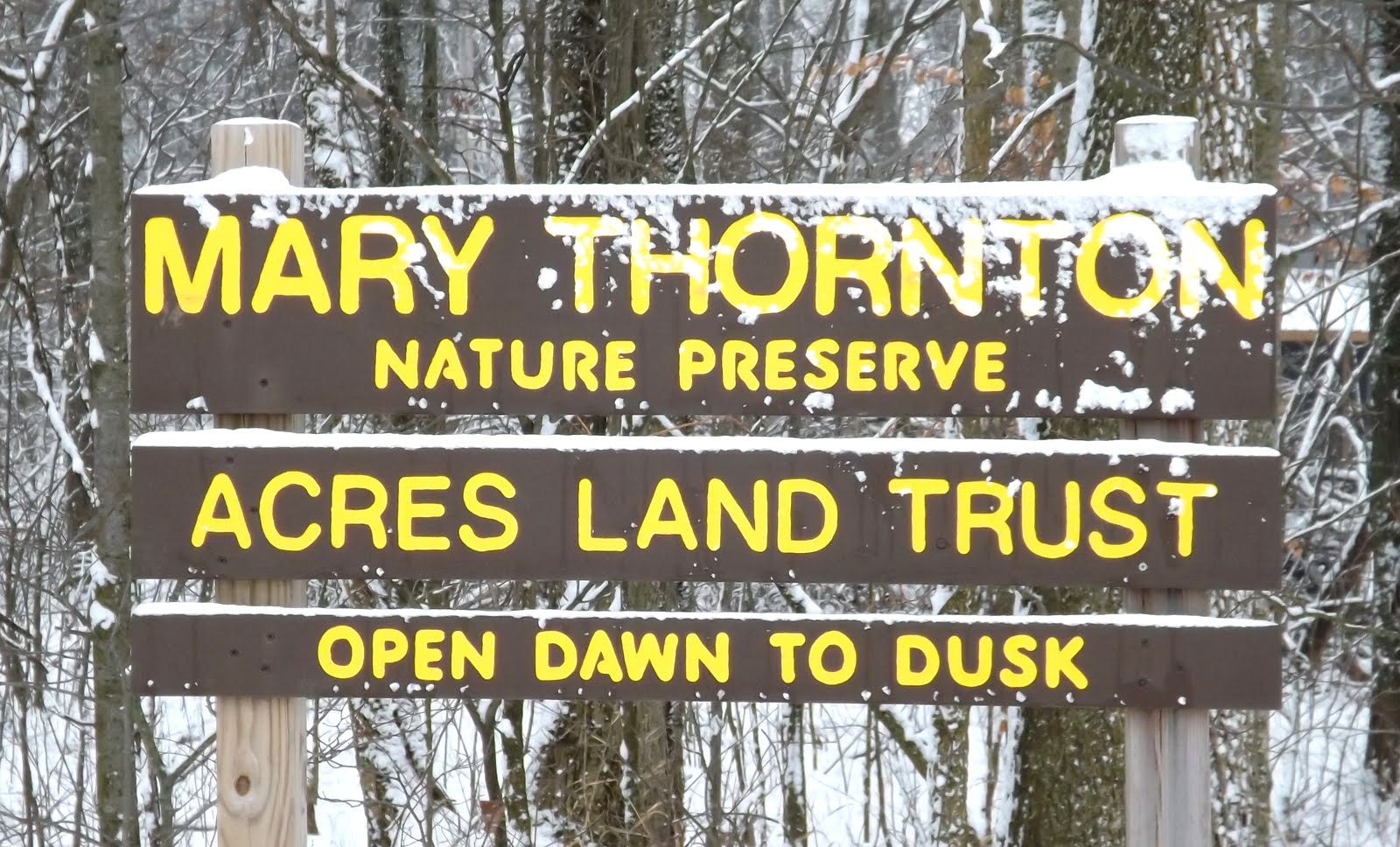
Mary Thornton Nature Preserve, Wabash County

Walking in a wintery wonderland at...
Mary Thornton Nature Preserve, Wabash County, Indiana
      The last couple of winters around here have produced little in the way of measurable snowfall, sadly.  I have become anxious about receiving visual inspiration for my Lilly Teacher Creativity Fellowship project's "Winter" stained glass panel. What's winter with no snow? Brown, that's what.
A snowy path through Mary Thornton's woods.
      Luckily, Mother Nature finally decided to bestow upon us some of the white stuff. Not enough to cancel school, (not even a delay!) but enough to provide me with a snowy photo op, and hopefully some wintery inspiration.
A perfect winter snow: soft, fluffy, and peaceful.
      My time spent outside during my Teacher Renewal Grant has taught me that I can learn to be more outdoorsy. In fact, I have come to crave being enveloped in the great outdoors - the colors, the air, the sounds and smells.  However, the preparations required for an outdoor adventure in the dead of winter is not a craving that I have yet acquired.
There's so much to do...long johns, socks, another pair of socks, heavy jeans (for those of us who own no coveralls or snowmobile suit)...
...long sleeved shirt, sweatshirt, hair pulled back, sock hat, hair taken down because a sock hat hurts with a pony tail, snow boots made one size too small from two pairs of socks...
...scarf, winter coat zipped up, winter coat unzipped due to aforementioned scarf caught in zipper, coat zipped again, gloves with removable finger covers for camera clicking, sunglasses for blinding snow...
...and finally, off to the woods!
      If I had to get in a car and drive to a nature preserve after all the effort of preparing for it, my "Winter" inspirations would probably be sourced from Google.  Lucky for me, the Mary Thornton Nature Preserve is a mere quarter mile walk from our front door.  Doable, even with my extra tight boots.  
Many fungi do not die in the winter. Several types of lichen and fungi are able to dehydrate their cells to prevent cellular freezing. They lie dormant until they are free from ice and suitable weather conditions have returned.
       Once inside the preserve, I was surrounded by a pristine, white blanket of snow.  Much of nature's details were hidden from view, but I was able to find several varieties of friendly fungus.  
Try as I might throughout the preserve, I was unable to find many colors.  I saw a lot of white (duh), brown, and oranges.  And this welcomed, be it tiny, bit of green moss.  
It can take years for bracket fungi, like this Turkey Tail variety, to break down and decompose a fallen tree.  The concentric lines you see on these fungi are growth rings, giving you an idea how long they've been working on this hunk of wood.
     This nature preserve is a small one, so I was finished with my picture-taking and snow-hiking before too long.  But the stillness of the frosty air and the gentle snowfall was so peaceful that I found myself lingering just a little longer within nature's wintertime splendor.  

Woods in Winter


~Henry Wadsworth Longfellow
When winter winds are piercing chill,
  And through the hawthorn blows the gale,
With solemn feet I tread the hill,
  That overbrows the lonely vale. 

O'er the bare upland, and away
  Through the long reach of desert woods,
The embracing sunbeams chastely play,
  And gladden these deep solitudes. 

Where, twisted round the barren oak,
  The summer vine in beauty clung,
And summer winds the stillness broke,
  The crystal icicle is hung. 

Where, from their frozen urns, mute springs
  Pour out the river's gradual tide,
Shrilly the skater's iron rings,
  And voices fill the woodland side. 

Alas! how changed from the fair scene,
  When birds sang out their mellow lay,
And winds were soft, and woods were green,
  And the song ceased not with the day! 

But still wild music is abroad,
  Pale, desert woods! within your crowd;
And gathering winds, in hoarse accord,
  Amid the vocal reeds pipe loud.
 
Chill airs and wintry winds! my ear
  Has grown familiar with your song;
I hear it in the opening year,
  I listen, and it cheers me long.