Showing posts with label Allen county. Show all posts

Thursday, January 3, 2013

Little Cedar Creek Wildlife Sanctuary, Allen County

Little Cedar Creek Sanctuary Nature Preserve
      I was recently looking through some photographs that I had forgotten were on my camera's memory card, and realized that I had neglected to blog about my family's most recent hiking adventure.  In October we visited the Little Cedar Creek Wildlife Sanctuary in Allen County.  This is the only hike we were able to take during the colorful fall months so I was eager to find and photograph some of nature's autumn splendor.  I wasn't disappointed...
This preserve is a floodplain forest where the drainage divides between the Eel, Wabash, Saint Joe, and Maumee Rivers.  I'm not sure which river this part of Little Cedar Creek is headed for, but don't the fall colors reflecting off the water's surface look gorgeous?
      Nothing says "fall" like colorful foliage...


...and fungus!
LichenLichen is a primitive plant species that consists of strands of alga linked with roots and branches of a fungus that together absorb minerals from the ground and conduct photosynthesis.  Lichen can grow almost anywhere from moist bark, to recently cooled lava, to frozen rocks.
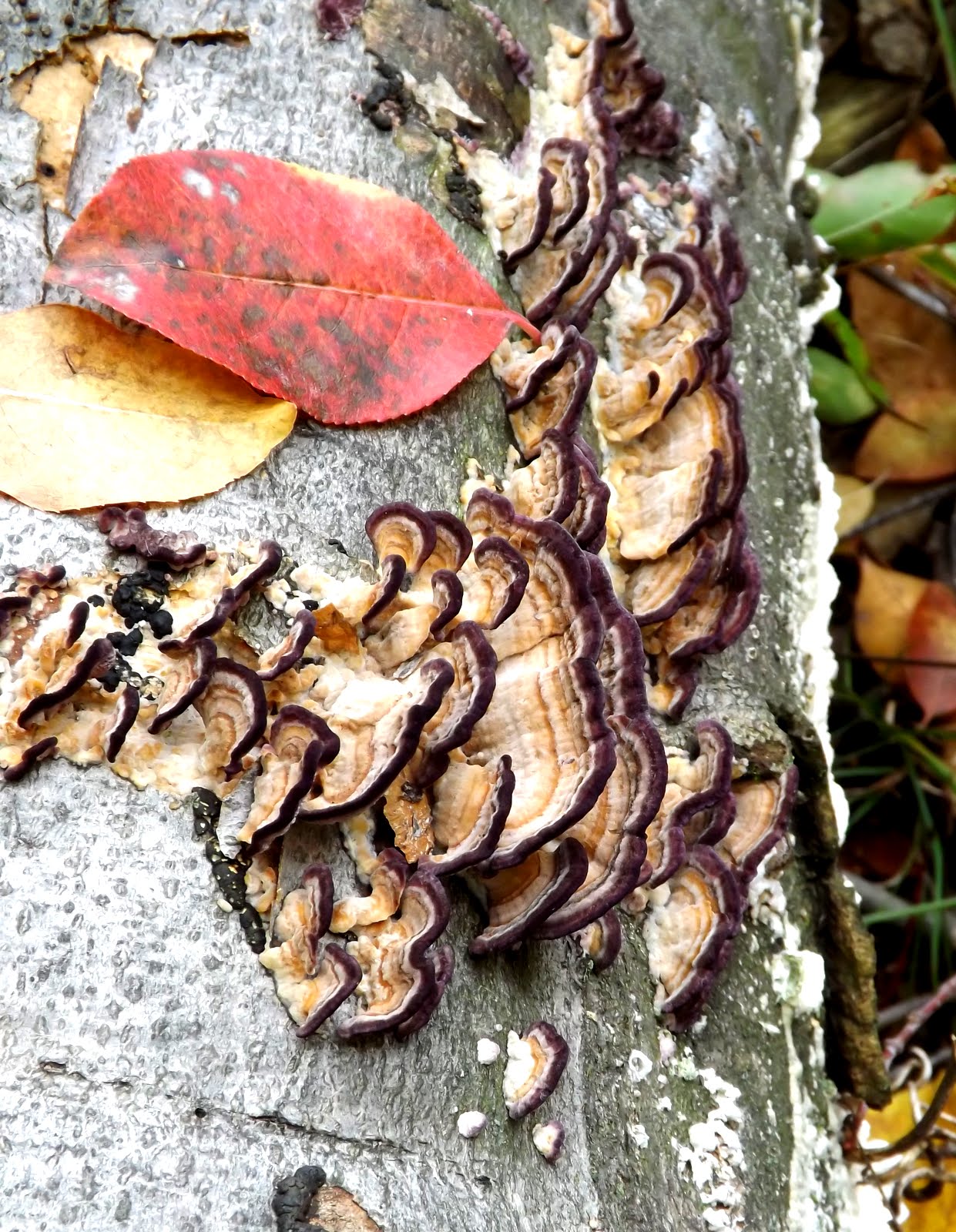
Turkey Tail bracket fungus
 I love the deep purple edge on these mushrooms!
More Turkey Tail fungus
Bracket, or shelf, fungi are decay organisms.  Their job is to decompose the dead wood they feed on so the nutrients can be recycled by new plants and animals.  
As you can see, Turkey Tail mushrooms come in many different shapes, sizes, and colors.
      As excited as I was for beautiful fall photos, the kids were on the look out for more tangible souvenirs of the season.  
Hank and Evelynn are going on a leaf hunt!


Hank showing off a few of his colorful finds. 
       By the time we left the preserve, Hank and Evelynn had acquired quite a collection of beautiful, and somewhat soggy, autumn leaves.  They were busy plotting and planning what they would do with their collection almost all the way home. 
       I am blogging in December about a hike from October because I forgot about my camera's memory card stashed in my backpack.  Yeah...the leaves are still there, too.

Wednesday, August 15, 2012

Foxfire Woods, Allen County

      Just a few short miles from our last hiking destination, Vandolah Nature Preserve, is Foxfire Woods.  So it was only logical that upon leaving Vandolah we make the short drive for another hiking adventure.  The weather was (for once) very mild, so why not?!
Foxfire Woods Natural Area
      Foxfire Woods was gifted to Acres in 1974 from Mr. and Mrs. Glenn Poe, making it the first established ACRES Land Trust nature preserve in Allen County.  These woods are named after "foxfire," a general term for fungus that glows in the dark.
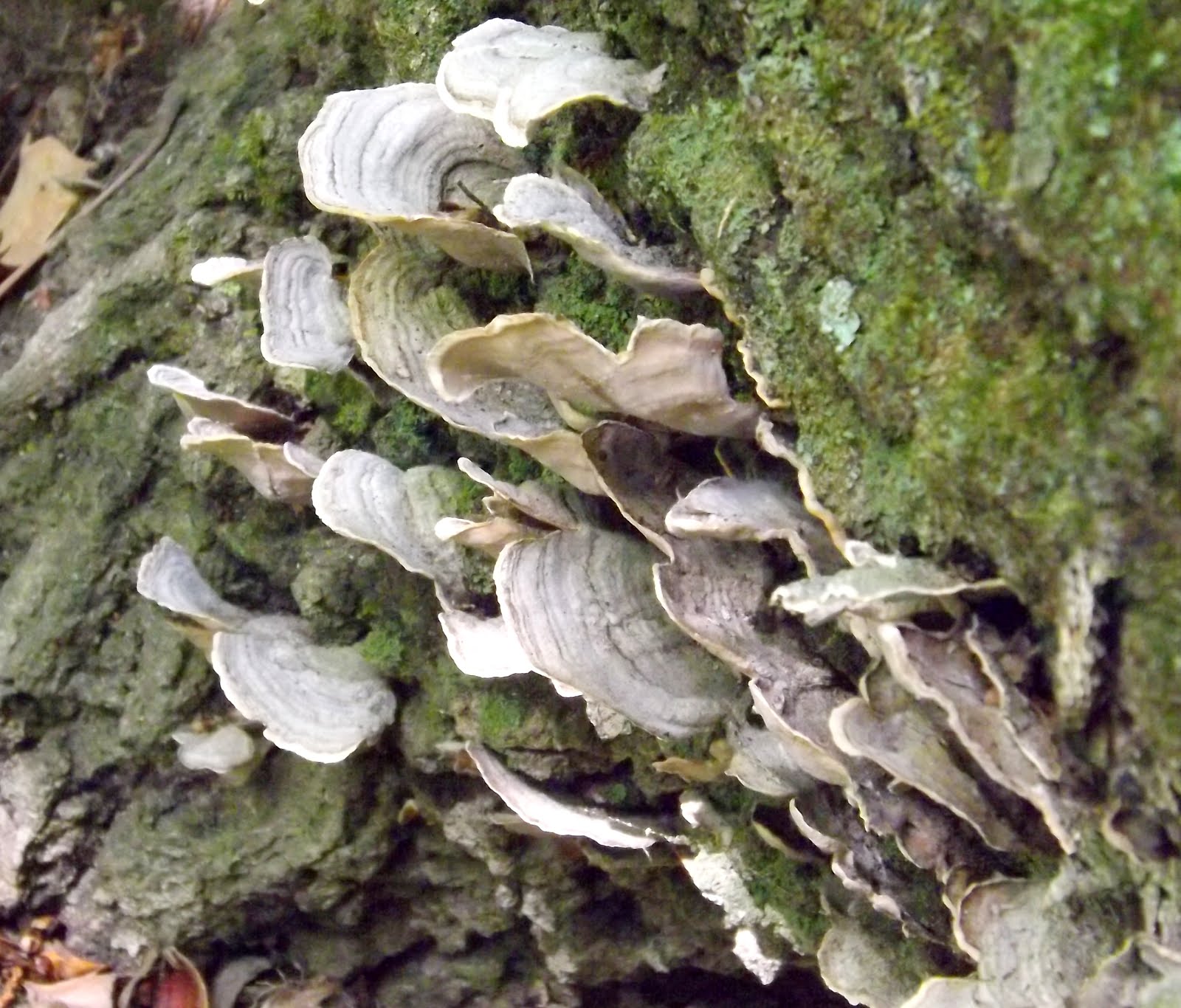
Turkey Tail, a decay fungus feeding on rotten wood
      Working under the assumption that this preserve is named "Foxfire" because there is glowing foxfire fungus here, I was determined to find some.  It had rained recently (finally!) so things were a little more moist and fungus was a bit easier to spot.  However, I had one great disadvantage...it was daytime.  If there was glowing fungus here, I would have to find it in it's non-glowing form.  


Slime mold plasmodium.
Like the name implies, slime molds appear as gelatinous "slime." However, the "mold" part of their name is a lie. Slime mold is a protist.  Fungi are molds, but slimes are not. Get it? Me neither.

 Like fungi, slimes contribute to the decomposition of dead vegetation by feeding on decaying plant matter, as well as tiny microorganisms within. Unlike fungi, slimes move! When food is plentiful, a slime mold exists as a single-celled organism.  But when food is in short supply slime molds congregate and start moving as a single body, called a plasmodium. When the weather is hot and dry for an extended period the plasmodium creates a tough outer layer, as seen above, to protect the cells within until better conditions for growth return. Predatory slime mold plasmodiums can move at speeds up to 1 millimeter per hour (where's the fire?!) seeking bacteria or fungi to consume. Another difference between slime molds and fungi is that slimes engulf and ingest their food as they flow over it.  If it turns out to be inedible, they eject it.  What an amazing creature!!
      So, I decided my best approach would be to photograph every type of fungus, protist, or mold I could find.  I would then do my research and find out which one of them was the mysterious glowing fungus.  

I've discovered that it's very difficult to identify fungus that is old, dry and crusty from months of being cooked by the hot, burning sun.  I'm sure these shelf fungi used to be more attractive than these week-old-hamburger-patty looking things.
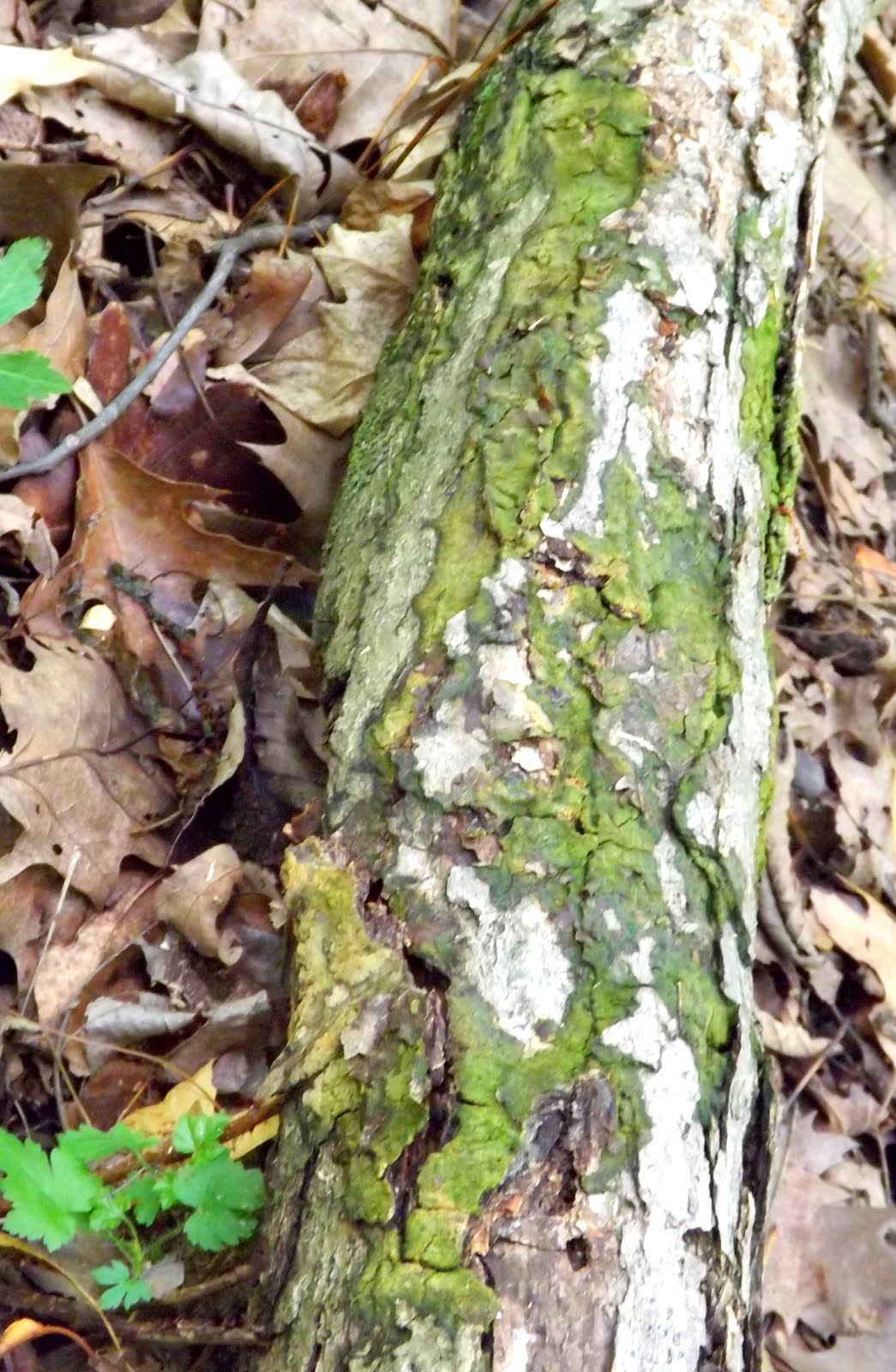
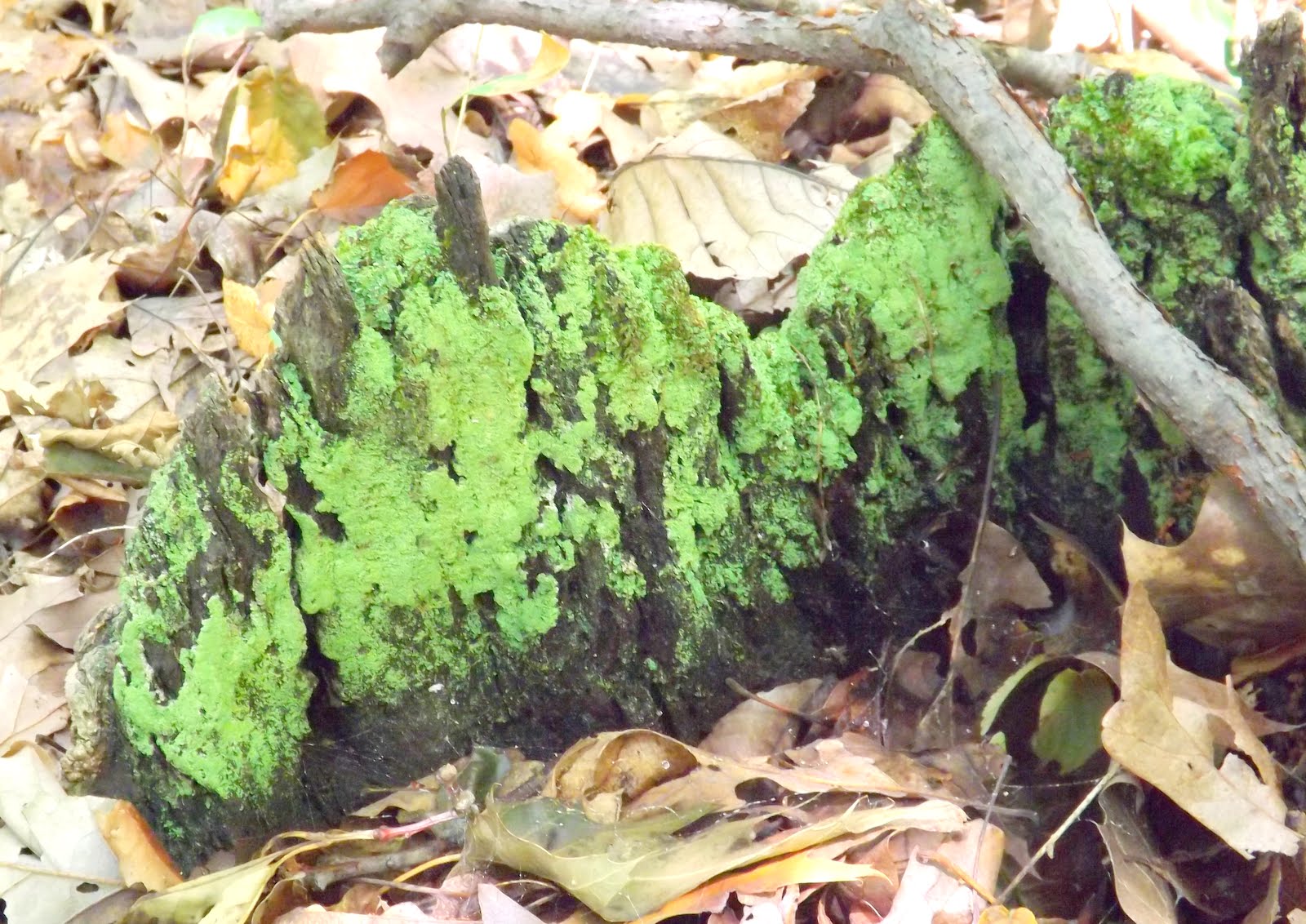
Is it moss?  Is it algae?
Did you know...there are more than 12,500 species of mosses and more than
7,000 species of green algae.  
Milk-White Toothed Polypore
So what is the difference between moss and algae?
Even though it is believed that moss developed directly from algae around 350 million years ago, algae and moss each have their own scientific classification.  Moss is classified as a bryophyte, a type of tiny plant suited to moist, but land-based, conditions.  Algae is a eukaryote, a single-celled plant generally growing with others in clusters.   Moss looks fibrous or feathered up close, and when germinating moss puts up thin stems containing reproductive spores and sometimes tiny leaves.  Algae have no threadlike structures or leaves, but rather spread as a clump of living cells. Algae usually looks like a slimy, wet mass, often green in color. 


      So do any of these fungi, molds, algae, or protists glow in the dark??  After hours of strenuous research, the answer is.... probably not.  These are the most common foxfire producing fungi...

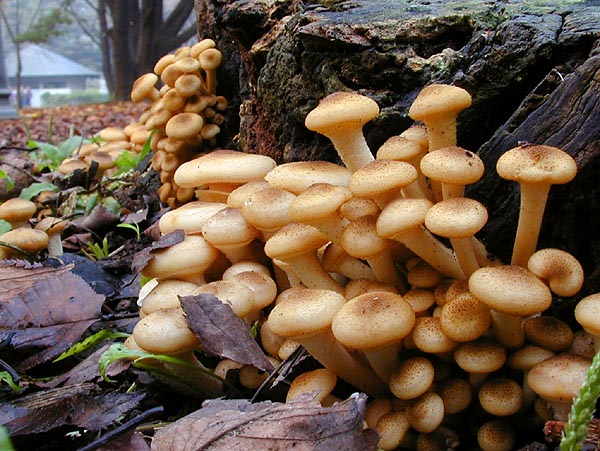
Armillaria mellea or Honey Fungus
http://www.fcps.edu/islandcreekes/ecology/honey_mushroom.htm
Mycena chlorophos or Pixies' Parasol
http://en.wikipedia.org/wiki/Mycena
Panellus stipticus or Bitter Oyster
http://www.itsnature.org/plant_life/vegetation-plants/bitter-oyster/
Omphalotus olearius or Jack o'Lantern Mushroom
http://www.mushroom-appreciation.com/omphalotus-olearius.html
      And none of them look like anything caught by my camera at Foxfire Woods.  I'd be a liar if I didn't admit to a bit of disappointment.  However, this gives me a very good reason to return to Foxfire woods, perhaps in the fall?  And definitely after dark!  


Monday, July 16, 2012

Maumee River Overlook, Allen County


http://www.acreslandtrust.org/templates/System/details.asp?id=44551&PID=635632
      On a very hot day, when everyone had finally achieved exhaustion from a week full of 4-H fair duties, competitions, and of course, midway rides, I planned a preserve hike. I picked the Maumee River Overlook Nature Preserve for two reasons: 1) it is very far away, necessitating a long, relaxing drive in a frosty-cool air-conditioned car, and 2) I knew it was a very, VERY small preserve and would require hardly any hiking. 

Hank and Evelynn racing to the end of the trail.  
     We were not to be disappointed. This preserve in a single acre of land, with about 1/10th of a mile of trails...er, trail. Evelynn and Hank walked quickly to the end, turned around, and announced that it was time to go to the nearest McDonald's.  
Overlooking the Maumee River...I think?
      When the land was given to ACRES in 1976 as a gift, it offered a panoramic view of the Maumee River. Visitors looking east could even see the riffling waters of Bull Rapids, the site of a water powered sawmill in the 1870's. This sawmill provided lumber used to construct the Wabash-Erie canal, which was located along the southern border of the preserve. 
  
A spy's view of the opposite river bank.
      However, the view from atop the steep bluff today is quite obscured by trees, foliage, and typical woodland undergrowth. We were a little disappointed that we could not actually over look the Maumee River.  
The zoom on my camera caught a few peeks of the illusive river view.
      We caught occasional glimpses of the flowing river waters through tiny windows in the foliage, and were seriously tempted to go off-trail hiking down the steep incline to the water's edge.  But our flip-flops and exhaustion from the prior week's activities got the better of us, and we opted for a family discussion about how forests grow and evolve over time, and how it is actually a good, healthy sign that we can no longer see the river from this trail.  
      Not allowed a river view, we focused on the things we could see around us, and discovered these...


Ohio Buckeyes.
Inside these bumpy hulls are the nuts of the buckeye tree.  In September the hulls will
become ripe, split open, and drop their shiny brown nuts to the ground.  The name "Buckeye"
 came from the Native Americans who noticed that the glossy brown seeds with the lighter
circular "eye" looked very similar to the eye of a buck deer.  

Many consider buckeye nuts to be good luck charms.
And if you suffer from rheumatism or arthritis pain, carrying a buckeye in
your pocket is said to bring relief.  
An omen of an early autumn? Or just evidence of a really dry summer?
Hot, dry weather will speed up the rate at which pine cones open up and release their seeds.  
Basswood.
 Leaves turning yellow like these are a sign that the tree is not getting enough water.  
      After hiking a full 2/10th's of a mile into and back out of the preserve and taking a few interesting snapshots, it was time to head home again.  Today we were thankful for a quick and easy hike, and a functioning a/c!  See you next time.


Thursday, July 5, 2012

The Bicentennial Woods, Allen County

      After hiking the last two nature preserves with my adoring husband, Sherman, and his faithful companion, Cell Phone, I decided to once again hike alone.  
http://www.acreslandtrust.org/templates/System/details.asp?id=44551&PID=630179
      This solo venture brings me to The Bicentennial Woods, a hilly 80 acre preserve in northern Allen county. The property was acquired to honor Fort Wayne's Bicentennial in 1994. 
Willow Creek, a tributary of Cedar Creek
      As Fort Wayne approached its 200th anniversary, ACRES began looking for an appropriate property to commemorate the historic event.  
A small stream leading to Willow Creek
      The Bicentennial Woods location was selected because the gigantic trees growing here are representative of what much of the area looked like before it was settled.  
One of several scenic bridges within The Bicentennial Woods preserve
      Only a few trees have ever been removed from this property, which is believed to the last stand of virgin timber in Allen County. Stately oak trees, some with trunks nearing four feet in diameter, and huge sycamores dominate this hilly, heavily wooded preserve.

I'm sure this knobby tree formation is here for some interesting scientific reason.
However, my brain can only see one thing...
ShadeMaster from Genuine Tree Peeple
An amazingly textural, twisted tree
      Besides the towering oaks, hickories, sycamores, and dogwoods that surrounded me, I also took in these interesting sights...
Even the bracket fungi look like they need some rain.
Dryad's Saddle, polypore bracket fungus
The name "Dryad's Saddle" refers to tree nymphs of Greek mythology called dryads.  According to legends, dryads are small, shy wood spirits who look after the forest and keep an eye on the health of the trees.  This mushroom's shape and size make it a suitable, and probably rather comfortable, seat for a dryad. 

The Wood Nymph, 1898
by Charles Marion Russell
Chickweed
In folklore, a sprig of chickweed carried in your pocket was said to draw the attention of a
 loved one or ensure the fidelity of your mate.

A crazy, wild stand of creeping, crawling, hanging vines.

"The vine embraces the elm, and other plants cling to the vine.
So that things which have no powers of sense to perceive anything else,
 seem strongly to feel the advantages of union."
~Desiderius Erasmus, 1521


      I would enjoy a return trip to Bicentennial woods. Perhaps the fall, when the leaves are turning, would be a good time to share this little part of Indiana's natural splendor with my kids.  And who knows...maybe Sherman and Cell Phone will join us, too!

Tom and Jane Dustin Nature Preserve, Allen County

      The husband/wife nature hike continues as my special hiking companion, hubby Sherman,  accompanies me to the Tom and Jane Dustin Nature Preserve in Allen County.
http://www.acreslandtrust.org/templates/System/details.asp?id=44551&PID=697595
      If you visited my last post, you know my husband, Sherman, is my hiking companion today, and we started our hike at the Robert C. and Rosella C. Johnson preserve which is immediately adjacent to the Dustin preserve.  


A peek at Cedar Creek
      By now, we know we've crossed over into the Dustin preserve because we have reached Cedar Creek. Cedar Creek forms the southern boundry of this preserve, and is a State Scenic and Recreational River.  There are only 3 rivers in Indiana with this designation. (The others are Wildcat Creek in Tippecanoe and Carroll counties and the Blue River in Harrison, Crawford, and Washington counties.)
A perfectly sunny day.  I love how the reflections of the trees in the water
look almost as lifelike as the real things.
      As the roadside sign says, the Dustin preserve is also the home of the Acres Land Trust office. Much of this preserve, including the house which is now Acres' administrative office, was originally owned by Tom and Jane Dustin.  The Dustins were eminent conservationists who helped pass many of Indiana's most significant pieces of conservation statutes, including the Nature Preserves Act and the Natural and Scenic Rivers Act.
Ready for duty.
Visitors to many Acres Land Trust preserves will see birdhouses like this  placed in strategic locations, providing bird habitats for nesting and raising birdie families.  I found these lined up on a shelf outside the Acres Land Trust office
This little guy was the only one working today at the Acres Land Trust offices.  
      Growing outside the office building we found several species of beautiful summer flowers.  I snapped away with my camera while Sherman sat on a bench and, well, texted.

Tiger lily.  We all drive by scads of tiger lilies growing along our roadsides all summer long.
But did you know... 
Native Americans used this flower for food, and tiger lilies are still dried, boiled, baked, or roasted and added to soups and stir-fry dishes in some regions of the world.  The Chinese have used tiger lilies medicinally for over 2000 years. The roots of the lily contain antibacterial, anti-parasitical, anti-inflammatory, and diuretic properties.  In herbal medicine, a tincture made from fresh tiger lily can be used in the treatment of uterine-neuralgia, congestion, and nausea.  Other uses include treatment for heart problems, eye problems, and for symptoms of menopause.
No longer will I take this common orange ditch flower for granted!

Crown Vetch
This invasive summertime wildflower is actually an herb in the legume family.
 That means it is a relative with peas and beans.  These flowers are very attractive to
 bees and butterflies, and as it turns out, poisonous for horses. 
 
Chameleon plant, or fishwort.
 This plant is native to Japan, Korea, southern China and southeast Asia.  One of the traditional asian terms for this plant is yúxīng cǎo which literally translates to "fishy-smell herb."
I guess we now know why it is also called "fishwort."

      After threatening to steal Sherman's cell phone away and toss it into the nearby Cedar Creek, he finally agreed to put it away for a while.  Long enough to hike back to the car, anyway. And it's a good thing, for if he hadn't stowed it away how could he have found these enormous, century-old trees? Trees that were no doubt here during the occupation of his own Native American ancestors.  Read more about tree growth, age, and how they've joined together here.


It's official!  Sherman is a tree-hugger!
      And how could we have witnessed this quintessential summertime vista together?  Dancing leaves silhouetted against an azure blue sky as perfectly white puffy clouds float by. I prefer this view over a text message any day!


"That beautiful season the Summer!
Filled was the air with a dreamy and magical light;
And the landscape lay as if new created
in all the freshness of childhood."
-  Henry Wadsworth Longfellow


      We should all lay down our cell phones once in a while, and enjoy the natural splendor that surrounds us, wherever we are!  See you next time!